Feature
Feature
By Angela Rakes
Innovations on the farm save money while honoring environmental commitments and increasing outreach.
In his 10 years as the farm director at the Loretto Motherhouse Farm, Cody Rakes has learned that innovations are essential to the farm’s success. Innovation could be something like the air seeder that is mounted on the combine for planting cover crops while harvesting, or it could be as simple as building a hooded sprayer that protects pumpkins while reducing weed pressure.
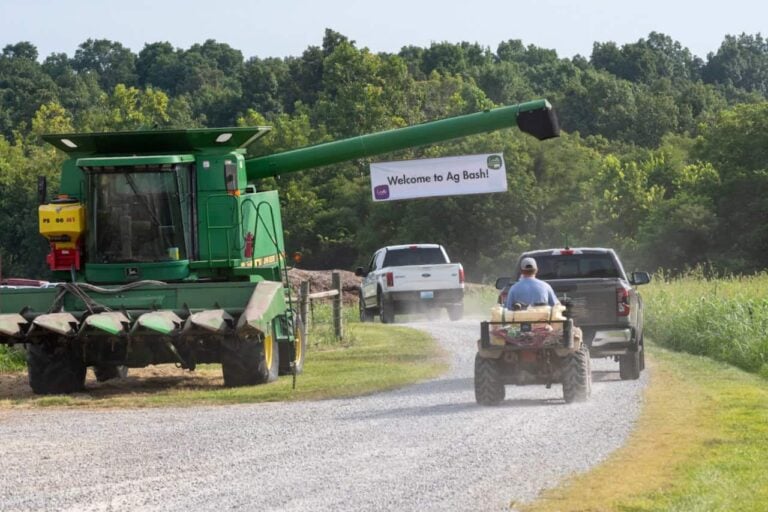
In 2020 through a project called the Soil Health Partnership, the Loretto Motherhouse Farm received an air seeder for planting cover crops at no cost. This seeder was mounted to the combine and for the last five years has planted hundreds of acres of cover crops while the combine is harvesting. This cuts labor costs and guarantees that a cover crop is planted on every acre, even when farm staff is unable to make it to the field with the seed drill. As a result of the data collected through the Soil Health Partnership on farms like ours, the Nature Conservancy and the United States Department of Agriculture Natural Resource Conservation Service have teamed up to start a new program in 11 Western Kentucky counties. According to a May 2025 Nature Conservancy article, thisprogram provides “cost share on approved equipment that allows cover crops to be inter-seeded or planted as a multi-task, such as with combine mounted or minimum till mounted cover crop seeders. This equipment cost share opportunity is the first of its kind in Kentucky.” It is exciting to know that a program that started on farms like the Loretto Motherhouse Farm has impacted the adoption of a new program that will have a positive financial impact to farmers while increasing the number of acres planted in cover crops.
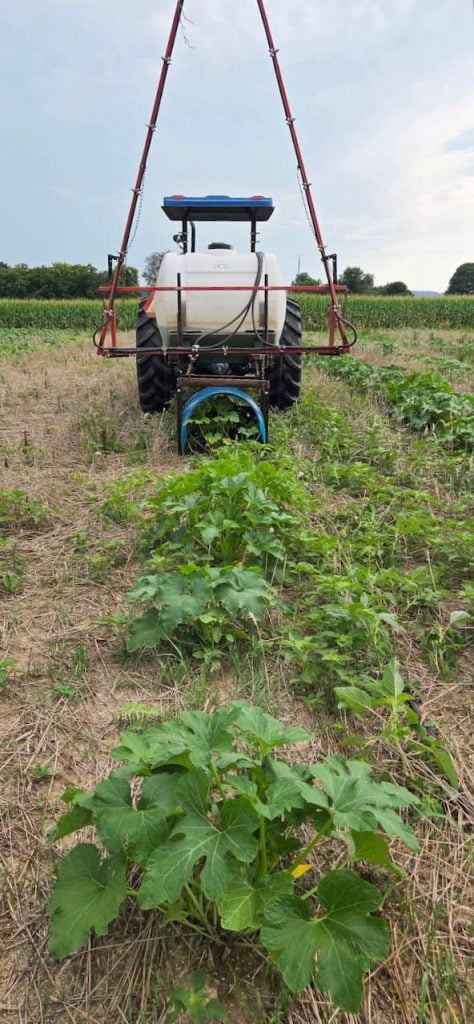
Speaking of cover crops, in an effort to save money last fall, most crop acres were planted in a less diverse cover crop mix that was mostly made up of the wheat the farm had grown that summer. While this was an effective cover crop by most criteria, it is a lower biomass crop that did not provide as much weed control in the pumpkins as we usually have with crops like hairy vetch. While doing what is termed as crop scouting this summer — basically checking on the crop and field health — Cody realized we were going to have to do more manual and herbicide weed control to save the pumpkin crop. Pumpkins are not resistant to the herbicides that are used to kill many of the weeds plaguing the pumpkin patch, so if we are going to responsibly use limited amounts of herbicides, the pumpkins must be protected. In small patches, farmers accomplish this by covering the plants with devices like buckets. That is an impossible task with thousands of plants. So Cody got busy, and with some recycled materials including
a 55-gallon plastic barrel and some scrap metal, he built a hood that attached to the sprayer. After some welding and sprayer modifications, the project was a success. As the tractor drove through the field spraying weeds, the pumpkins were nestled safely under the hood. This innovation saved the crop. This hood is not a new idea, there are manufactured hooded sprayers, but they are expensive and not readily available. The weed problem was not eliminated, but coupled with some mowing in the patch, the pumpkin crop looks to be a success.
Farming is constant innovation: analyzing cost versus benefit, modifying equipment to make it work instead of buying new and balancing that with a strong commitment to being good environmental stewards. This is how we maintain a successful and profitable farm at Loretto.