Feature
Feature
The Sisters of Loretto with their purely American heritage and spirit are of the very marrow of American history.
Florence Wolff SL
Editor’s note: In the fall 1976 issue of Loretto Magazine, Florence Wolff SL published “Loretto and the Bicentennial,” the story of Loretto’s history as it dovetails with the country’s. As the U.S. celebrates its sestercentennial, we offer an excerpt from Florence’s article.
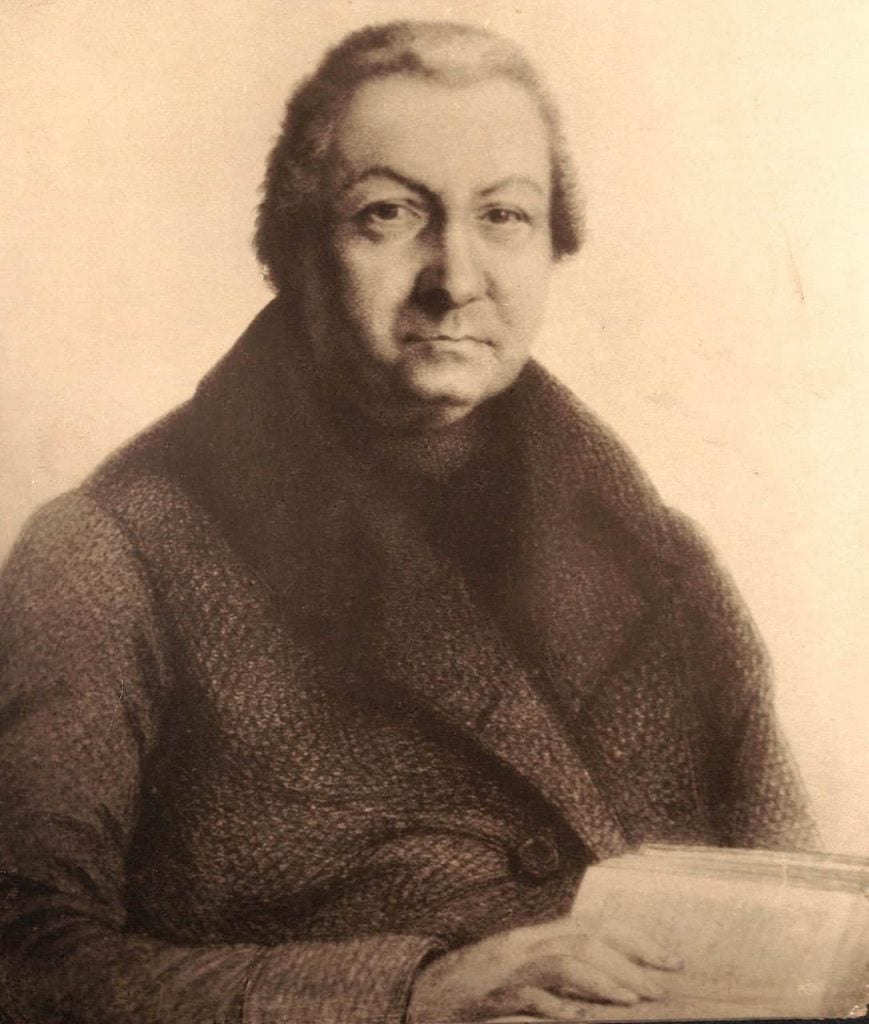
The year 1776 was an important one in the American colonies; it was also a special one in the family of Sebastian and Petronilla Nerinckx in Flanders when their seventh child, John Henry, was born. Charles, his oldest brother, was, at the time, already beginning his Latin studies preparatory to the philosophy and theology programs at Mechlin and Louvain. Both boys were to be much affected by the revolutionary activities of their lifetime, and both were to become priests and to join in founding religious communities of women engaged in teaching; the one in England, the other in America.
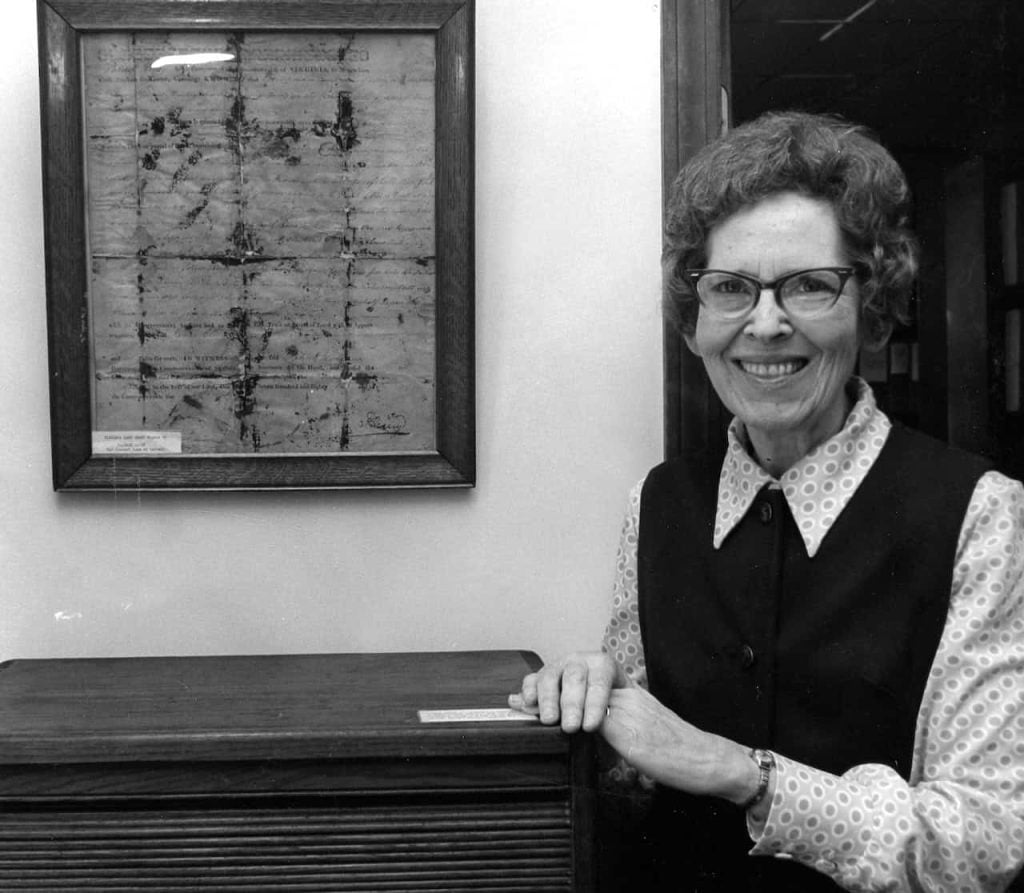
A precious document and several rare books link Loretto to the very first days of the new republic. The Treaty of Paris of 1783 extended the boundaries of the Commonwealth of Virginia west to the Mississippi, and thus included the present state of Kentucky. In the Archives, Loretto treasures a preemption treasury warrant, a land grant signed by Patrick Henry, April 1, 1784. [The land grant has since been sold.] In the fashion of these old surveys, the boundaries are indicated by such natural phenomena as specific kinds of trees, surrounding Indian Lick, “on both sides of the Rolling Fork.” The grant, no doubt, defines the land at Calvary, which became Loretto’s first branch establishment and where an academy was conducted from 1815 until the close of the century.
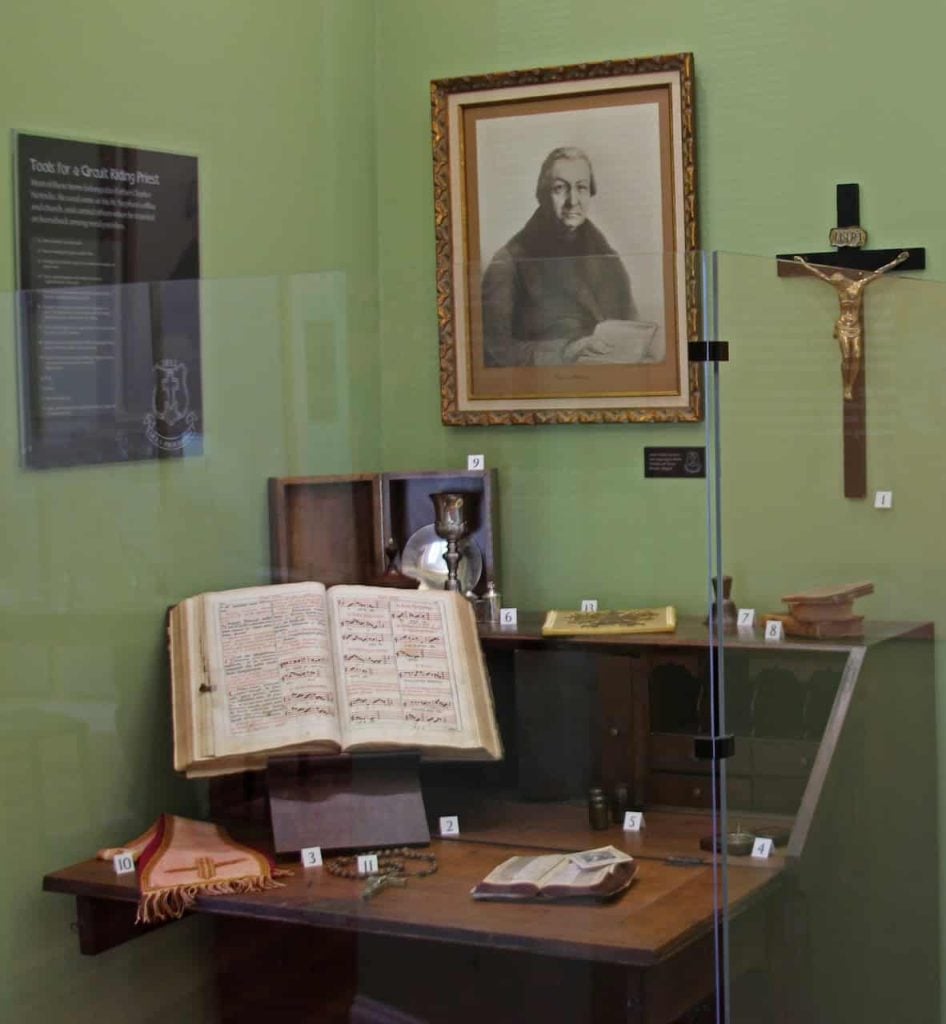
In 1790 the first Catholic Bible was printed in the new country, giving evidence of cultural and religious independence. Loretto cherishes three quarto volumes of this first edition, beautifully bound in tan leather, and inscribed by Bishop John Carroll to Rev. Stephen Theodore Badin and with the signature of Bishop Chabrat on the inside covers. [These volumes have since been sold.] All three men were involved with Loretto’s early history: Bishop Carroll, as the first bishop in the United States, welcomed Rev. Charles Nerinckx and assigned him to Kentucky; Father Badin was the first priest ordained in the United States and lived on the site of the present Motherhouse grounds; and Bishop Chabrat succeeded Father Nerinckx as ecclesiastical superior.
While constitutional convention was in session, and John Carroll was setting up his diocesan plans and procedures (1789), Father Nerinckx was beginning his exile from his parish ministry, because of his nonconformity with the revolutionary forces in Europe. Providentially, this disagreement was to be the prelude to his coming to America. He reached that decision in 1803, when the boundaries of the United States were enlarged by the famous Louisiana Purchase under Thomas Jefferson. It was in that territory that Father Nerinckx would later see the Sisters of Loretto make their first foundation in the Trans-Mississippi West, and it would be there that he would give back his missionary to His Maker. (Aug. 12, 1823, Ste. Genevieve, Mo.)
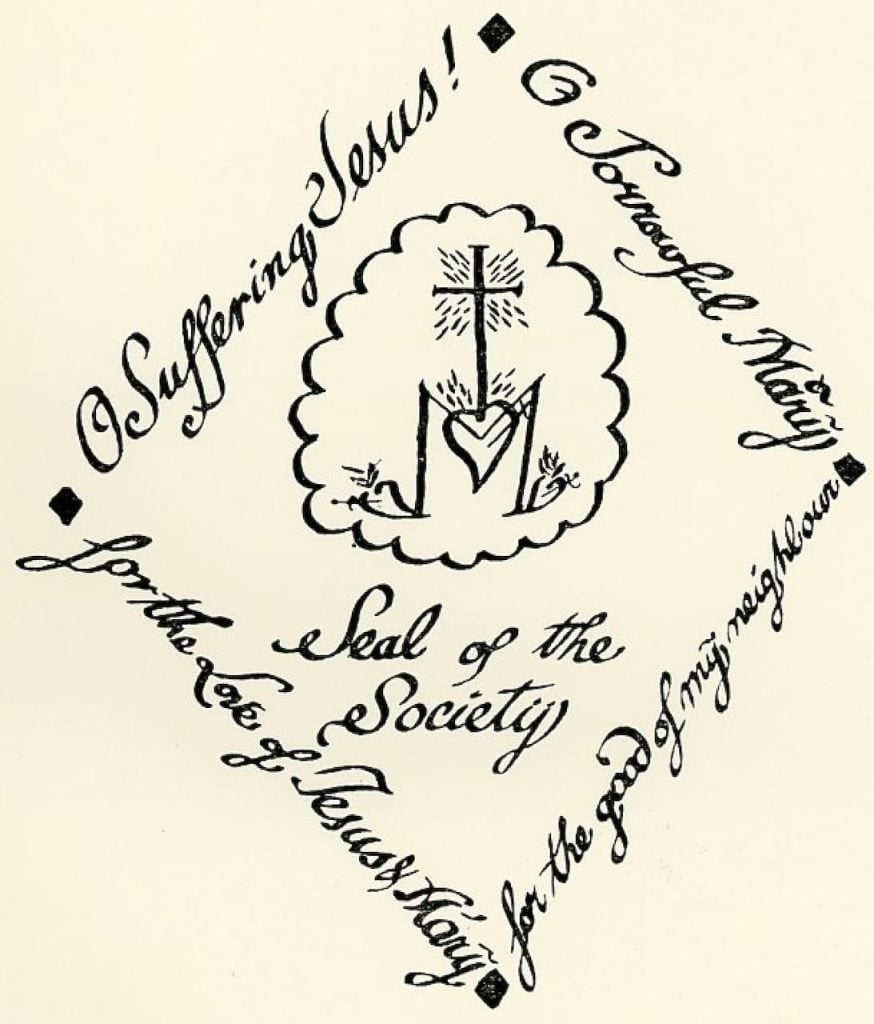
It was in Jefferson’s administration also, that Father Nerinckx came to America and soon was on his way to the young state of Kentucky to begin his arduous and extensive missionary labors. He rode by wagon trail and horseback over the trails blazed by the early American pioneers who had migrated to that part of the then far west of the United States.
In 1812 these pioneer Kentuckians were congealing into small communities, but being so far away from the Atlantic Coast, they felt little effects of the War between England and their country. It was that historic year, however, that marked the beginning of the Sisters of Loretto on Hardin’s Creek. Mary Rhodes, the co-founder with Father Nerinckx, had been born in Maryland during the very year Benjamin Franklin, John Jay and John Adams (1782) were in Paris negotiating the treaty which sealed the War for Independence. It was this young woman who, after her coming to Kentucky and seeing the lack of educational opportunities for the children, received the inspiration to open a school and to found a religious community which would seek the glory of God by praising Him and ministering to His people. From Mary Rhodes’s little log cabin school and convent would grow a congregation of American sisters who would thereafter be in the vanguard of American history.
Read all of the articles in the summer 2026 issue of Loretto Magazine.