LOREtto

LOREtto
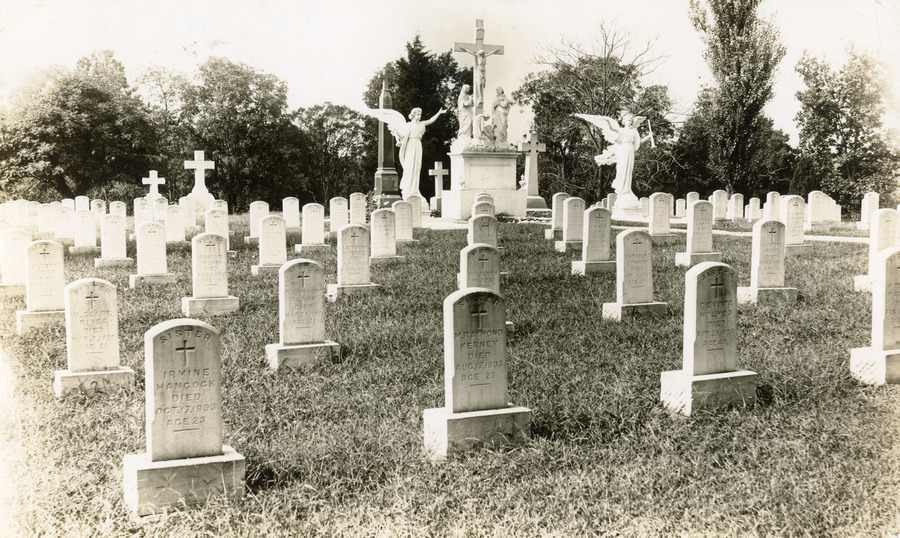
This summer, the Loretto Heritage Center and Loretto’s Communications Team is proud to launch our publicly accessible necrology and cemetery database. This searchable database will provide birth and death information for deceased Loretto Community members. The database will also indicate where individuals are buried (including exact section and row information for those buried at the Motherhouse). A photograph of the person and an obituary, when available, will also be displayed. Information will only be available for individuals who died as Loretto Sisters and Co-Members. Data on former members will not be publicly accessible.
This project has been several years in the works as it required us to sort out some anomalies that existed between the older necrology books that were kept and the information about members stored in the archives’ records. It also required Heritage Center staff to update our out-of-date records on Our Lady of Sorrows Cemetery at the Motherhouse. These updates included renumbering the cemetery rows and renaming the sections, updating information stored in our private database, pouring through cemetery and necrology records, and walking the cemetery rows to make sure no one was missing from the list! In the course of this work, a lot of questions about the cemetery popped up.
Here are a few of the questions we asked in the course of this work:
This was our obvious first question and one that is especially appropriate for archival staff to ask. Before attempting to sort out when a Sister actually died or where she might have been buried, we needed to know what records were created and kept in the past, which people or departments were responsible for keeping and creating those records, and whether or not those records were retained.
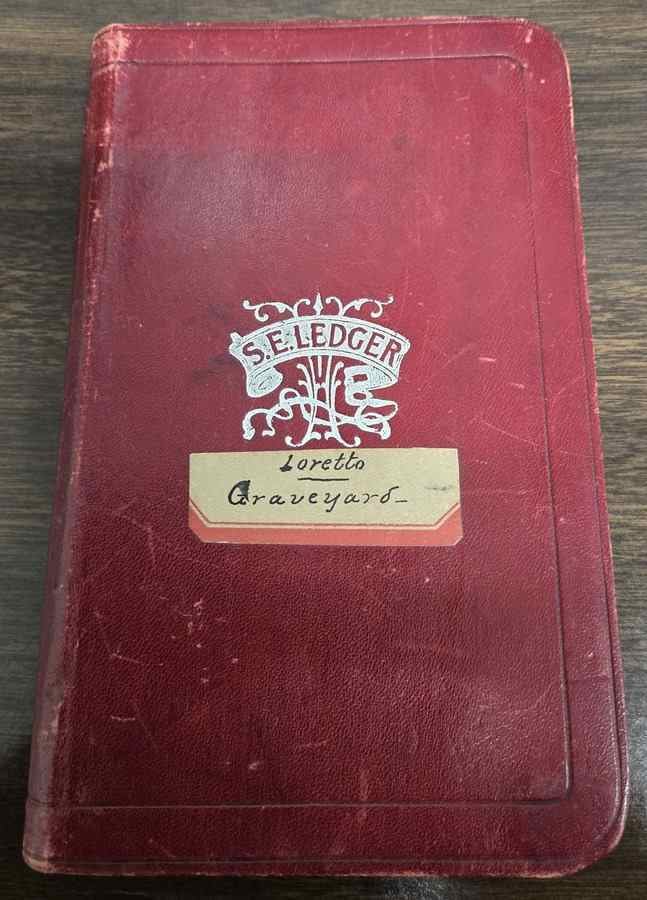
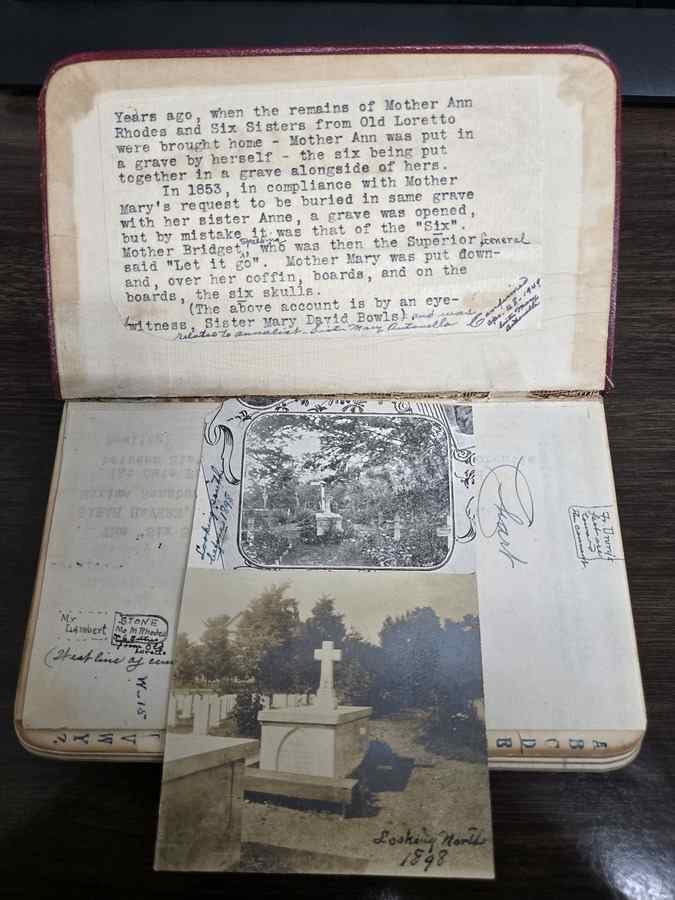
Early cemetery records are hard to come by. Most of the information we have come from early mortuary ledgers, which appear to have been transcribed into the ledgers from at least one other source over a short period of time (as pen strength and handwriting are mostly uniform). A typed document labeled “Retrospect” provides an overview of some of the cemetery information. The author of this document did not sign or date her work. The latest date mentioned in the document is 1938. A smaller notebook simply entitled “Loretto Cemetery” also provides a burial list. This notebook was last updated in 1979 and provides some interesting tidbits of information about the cemetery. A note in the front cover reads:
Years ago, when the remains of Mother Ann Rhodes and Six Sisters from Old Loretto were brought home – Mother Ann was put in a grave by herself – the six being put together in a grave alongside of hers. In 1853, in compliance with Mother Mary’s request to be buried in same [sic] grave with her Sister Anne [sic], a grave was opened, but by mistake it was that of the “Six.’ Mother Bridget [Spalding], who was then the Superior said ‘Let it go.’ Mother Mary was put down and, over her coffin, boards, and on the boards, the six skulls.
In later years, the cemetery records were kept by the office of the Service Coordinator. Some correspondence and other information was retained that helped answer a few questions we had. Sr. Katherine Ann Heinz took on the responsibility of keeping up the necrology books. She did this job from at least the 1980s until some point in the early 2000s. Later, Sr. Ceciliana Skees took on this duty. Last year, she passed that responsibility on to the archives.
Around 2014, the Loretto Heritage Center staff, with the help of Sr. Aggie Hoorman, RSCJ and others, undertook a large effort to update the cemetery records, map out the rows, and photograph the graves in the cemetery. Much of the work we have done this year is working off this earlier effort.
Unfortunately, this is one question that may never get an exact answer to. When trying to determine the exact number of people buried in the cemetery, a number of problems are encountered.
In some cases, Sisters cremains are buried in one location but she was memorialized in Our Lady of Sorrows. Sr. Susan Carol McDonald, for example, was buried in St. Louis but is memorialized in our cemetery. Many Sisters donated their bodies to science and so their cremains are returned long after they died. In a few instances, these Sisters are already engraved onto memorial slabs but their cremains have yet to be returned.
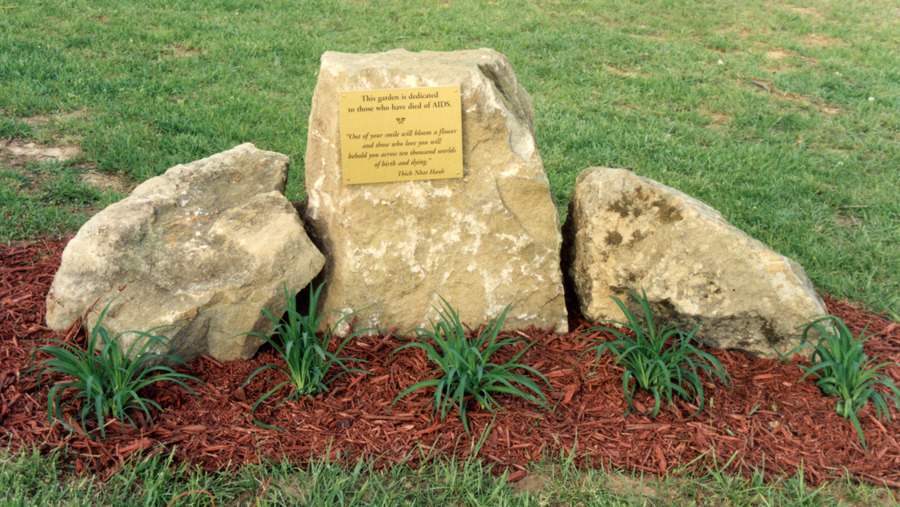
There are also a number of people buried in the AIDS Garden. These people were relatives of Sisters who died of AIDS. Records in the archives indicate that there are six or seven individuals buried in unmarked graves in the garden.
Finally, there is the question of enslaved people who died at the Motherhouse. There are no markers or records indicating where enslaved people who died while enslaved were buried. As we don’t even have sufficient records to determine how many individuals were enslaved on the property, we have no way of knowing how many people were buried here and whether or not they were buried in the vicinity of the cemetery. The first person known to be buried in the cemetery was Sr. Angelica Clements, who died in 1831. Were the enslaved people who died before her and after her buried somewhere near? The Slave Memorial in the cemetery is dedicated to those who gave lived their lives as forced laborers on the property, regardless of where they were buried.
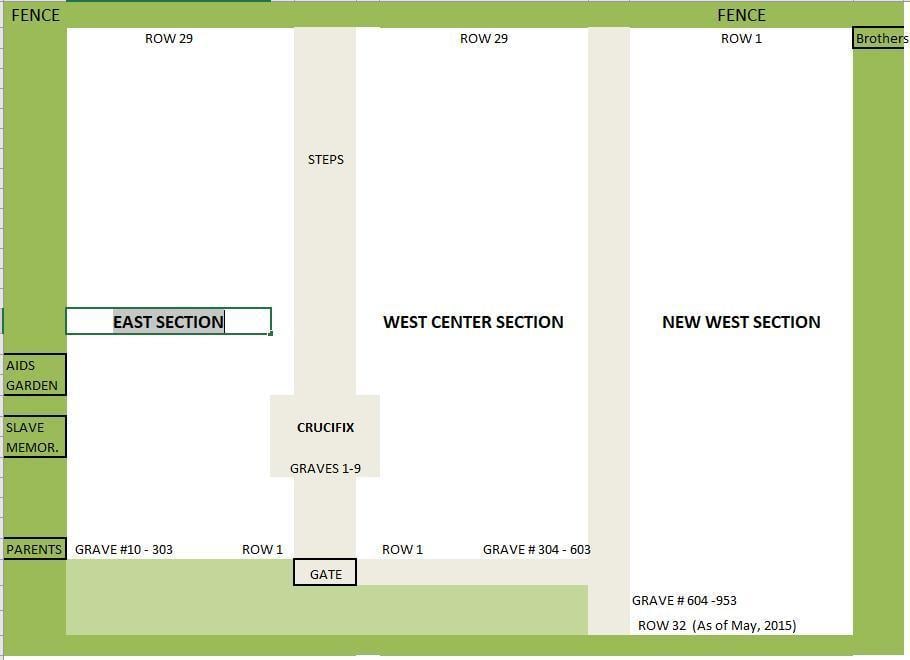
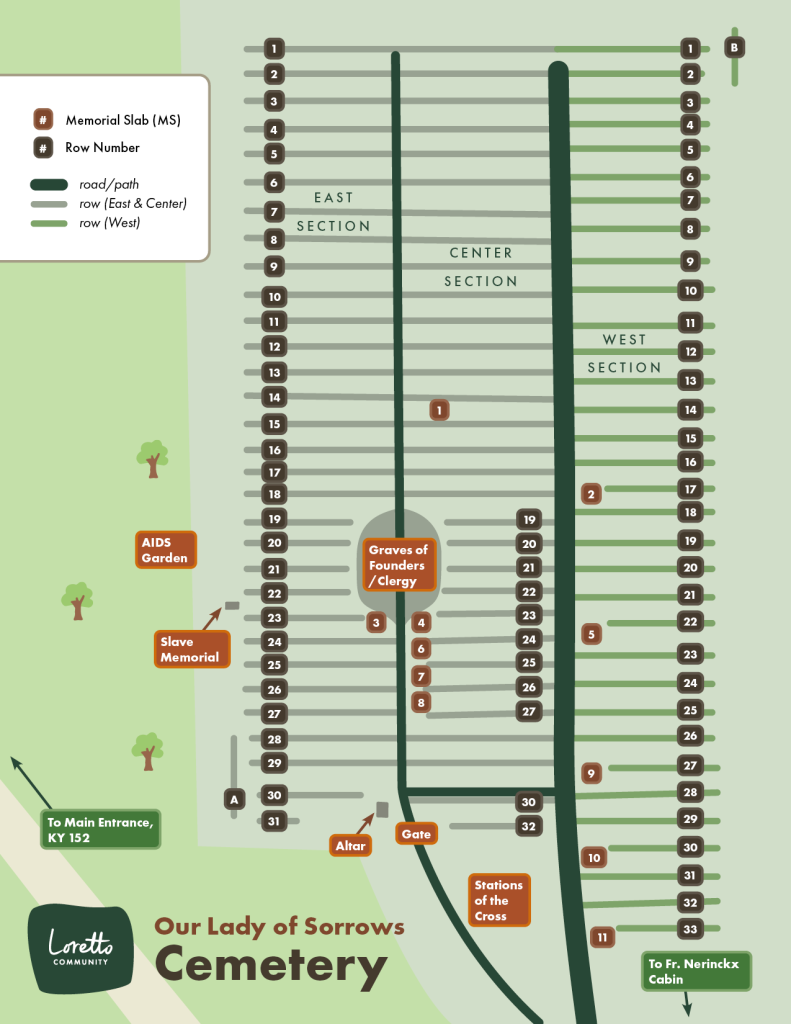
Here two maps of the cemetery, one which uses the old numbering system and one which uses the new numbering system. The old numbering system tells us a lot about how the cemetery grew as the order grew and more spaces were necessary. However, as a tool for locating were individuals are buried (especially for the public who are not familiar with the cemetery’s history), the old system is confusing. Notice how in the first two sections, rows are numbered from front to back, and then in the last section from back to front. This makes locating plots by row number very difficult. In the first two sections, new rows have been created in front of row number one, further confusing the issue.
The new numbering system counts rows from back to front in all sections. This allows for new rows to be continuously created in the front without confusing the overall numbering schema.
In the East Section of the cemetery in Row 24 (of the new numbering system), there is a headstone for a Benedict Mattingly who died on April 17, 1835 at the age of 16. But who is this Sr. Benedict? Archives staff has not been able to locate her in any of the existing records except in records where audits of the cemetery were conducted or in records where information about her was obviously obtained from her tombstone. Below is a photo of her card catalog record. Each Sister’s information was recorded on cards. Typically, the card catalog record includes the Sister’s birth name, her member number, reception date and age at reception, first and final profession dates, and death information. Benedict’s card catalog record only includes the information obtained from her tombstone. To be fair, Benedict is not the only person whose card catalog record is missing information. But her placement in the cemetery is also odd. Her headstone is between Sr. Adele Portier (died March 22, 1856) and Sr. Joseph Ann Gilbert (died November 24, 1856). While there are many other places where the rows do not move chronologically, when considered along with the missing information about her it does appear that this headstone might be incorrect.
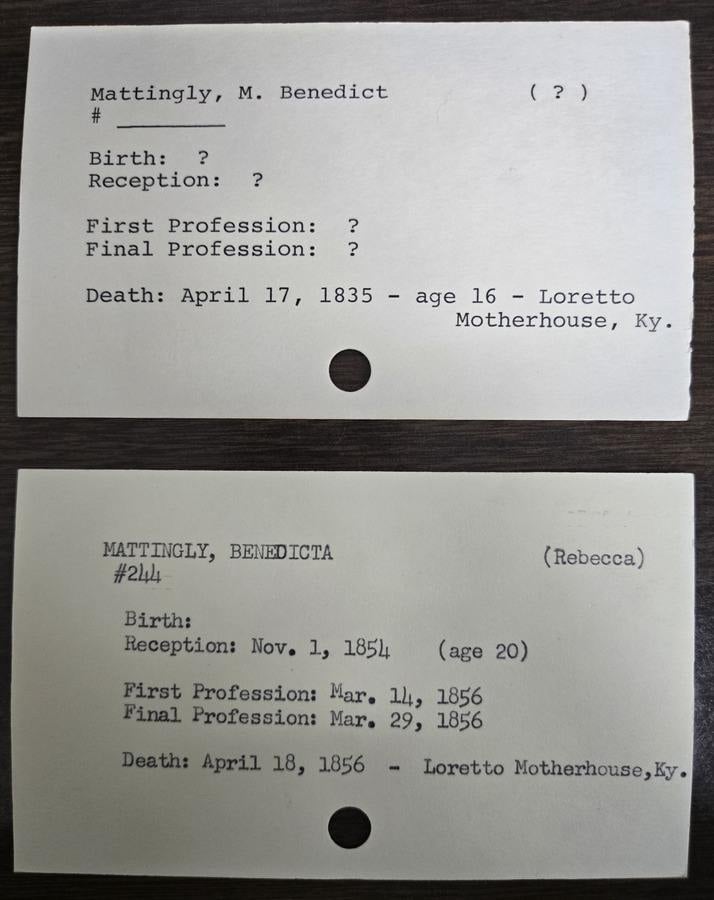
There was a Sr. Benedicta Mattingly. She was born Rebecca Mattingly and was received into the order on 1 November 1854 at the age of 20. She died on April 18, 1856. She does appear on at least one Mortuary List (where she is listed as dying at the Motherhouse) and on the Necrology lists we have in our collection. Could she be the person buried under the Benedict Mattingly headstone? Her date of death fits between Sr. Adele and Sr. Joseph Ann so it is definitely possible. Additionally, there is not a headstone for Sr. Benedicta in the cemetery despite her having died at the Motherhouse.
If in fact Sr. Benedict is actually Sr. Benedicta mislabeled, those unfamiliar with genealogical research might be quite shocked to find that this kind of thing is quite common. In earlier times, headstones were not always placed right away and if there was an absence of careful recording, misinformation may have been recorded on the stones. Also, stones were often replaced much later and the information for the new stone could have been misread off of the old stone. It is easy to see how the ‘a’ in Sr. Benedicta’s name could have been unreadable. Could 1856 been mistakenly read as 1835? Could April 18 have been misread as April 17? It certainly does not seem implausible. We do know that at some point in the mid-1900s new headstones were added to some older graves, whether in replacement of old stones or in lieu of some other type of marker. However, we have yet to locate written records of exactly when this happened or how the information for the new stones was obtained.
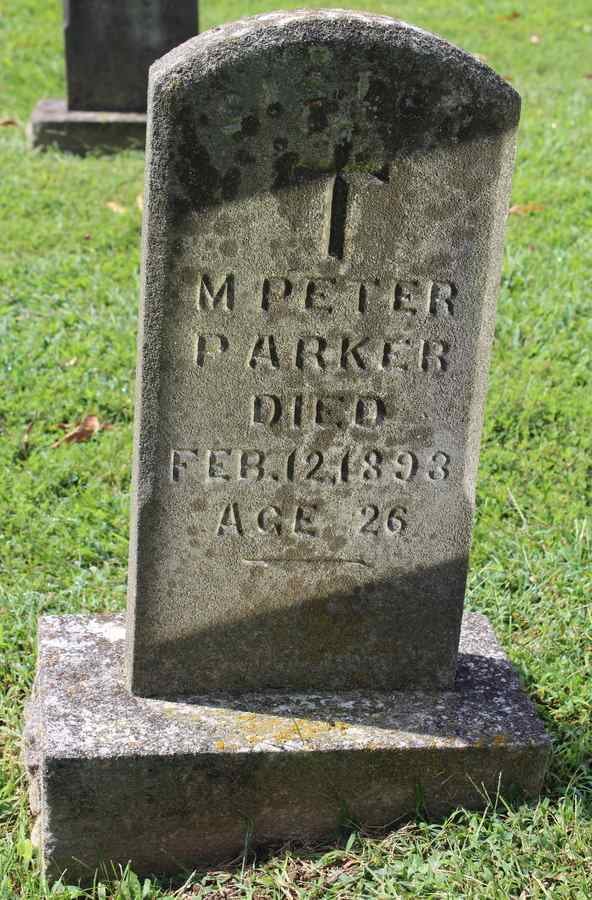
The answer to this question is, of course, a resounding “no!” Spiderman, whose non-superhero persona is Peter Parker, is not buried in Our Lady of Sorrows Cemetery. There is however an M. Peter Parker buried there. We do not have much information on Sr. M. Peter Parker but we do know that she was born Evelyne Parker and received into Loretto on August 15, 1890 at the age of 21. She died five years later at the age 26 while at the Motherhouse.
Of course, the nature of cemeteries is that the work on them is never really done. What questions about Our Lady of Sorrows Cemetery will we encounter in the future?