LOREtto

LOREtto
By Ashley Doughty
The Loretto Heritage Center was pleased to host Ashley as our summer intern. Ashley is spent the summer living at the Valley House and working with the personal papers of Sr. Maureen McCormack. Ashley comes to us from Paducah, KY and is currently the Bookmobile Coordinator at the McCracken County Public Library. She is working toward a Masters in Library and Information Science from the University of Illinois Urbana-Champaign.
I love the library – it all at once is a place that holds the promise of the written word, or answers to a question; it is a conduit for community building, and can even offer something as humanizing as acceptance. Libraries are for everyone, and finding records of the work the Sisters of Loretto have done in creating these safe spaces (in perhaps an unlikely place), gave me an opportunity to connect my work here with the work I’ll be returning to soon.
Sr. Joan Marie Rapier SL was born not too far from here, in New Haven, KY, on October 29th, 1887. She received the holy habit on August 15, 1910, and took her first vows exactly a year later, on August 15, 1911. Five years after that, on August 15, 1916, she took her final vows. Her first name was Sister Marie Joanna, but she later changed it to Sister Joan Marie.
Her assignments took her to several Loretto schools in St. Louis and in Louisville, and even as far west as Kansas City. Her longest, and last mission, was at Nerinx Hall and Webster College, in St. Louis, where she taught languages like French and Latin. While there, she also visited the St. Louis Jail, known then as the City Workhouse, every Sunday with Sr. Paula Caretto SL.
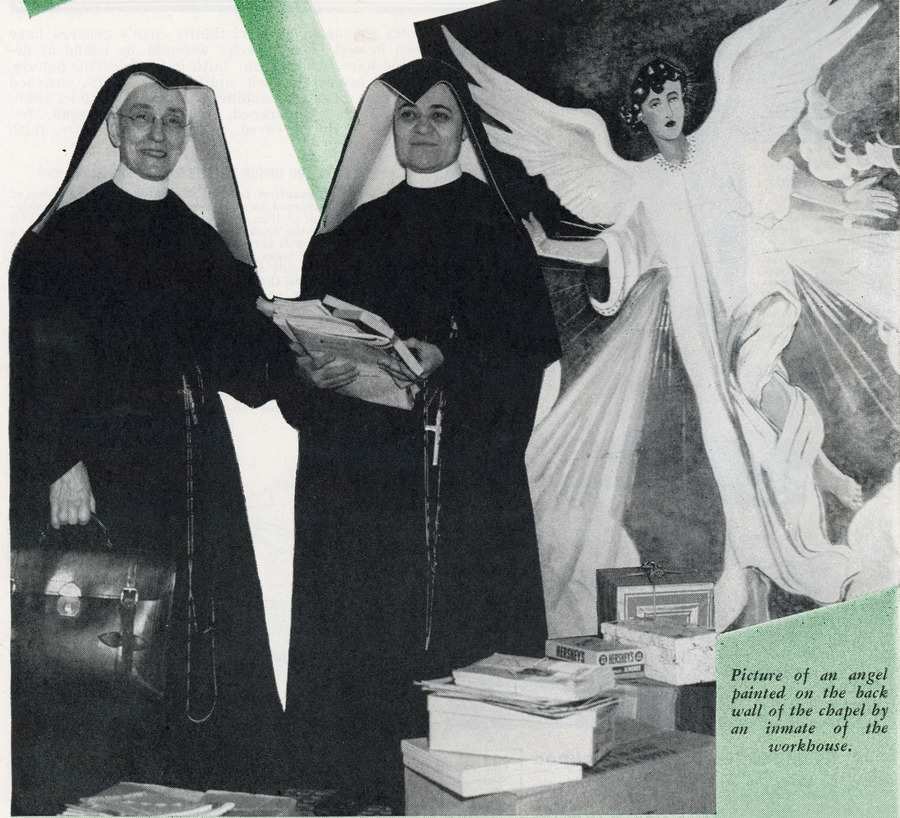
Sr. Paula Caretto SL was born on July 20, 1898 in Bisbee, Arizona. She received the holy habit on December 8, 1926, taking her first vows on December 9, 1927. She then took her final vows on August 15, 1931.
Her missions involved teaching at various Loretto schools, first in Denver, and then to Webster College. Sr. Paula was in charge of vocal music at Webster College starting in 1928, and continued this position until Webster became a secular college. She spent more than forty-two years as a music educator.
Together, these two sisters visited the City Workhouse almost every Sunday, for more than twenty years. One of the joys they were able to create for those imprisoned at the jail was a library. All libraries have a beginning, and luckily for us, Sr. Joan Marie compiled her experiences at the City Workhouse through written articles, called Jail Jottings.
From Sr. Joan Marie Rapier’s Jail Jottings, May 1951:
The library at City Workhouse developed from a rather humorous origin. We had been given many copies of Topix and Treasure Chest, and unwittingly placed them on a table in the large room called the “the library” – a misnomer at the time. The following week, we asked a guard how the inmates liked the comics. A puzzled look was the response – then, “I might as well tell you. The “boys” took the new magazines, sold them to place a few shekels in their own pockets.” Quick action was necessary. We betook ourselves to the Warden to obtain permission to start a library. Rather dubious, he granted our request. A Harvard man – a guard – was selected as librarian. Old, dilapidated books were burned, library case renovated, a campaign begun for replacement of books on empty shelves, and a checking system (imperative indeed under prison regulations) was begun. To date, seven hundred books have been donated, including sciences, history, biography, religious. Every two weeks, twenty-four books are sent to the Women’s Quarters that the “girls” may also profit by wholesome reading. In one week, thirty-two books were listed “out”. Each book that we have secured from Publishing companies, friends, and authors, we have marked with the letter M, after the example of our holy founder. We explain our marking system, and all we have to do is call the librarian to bring one of our books when we wish to advertise it to the class.
And later in the year, adjustments were made to create a more mobile library (something I hold dear to my heart as the bookmobile coordinator at my library).
From Sr. Joan Marie Rapier’s Jail Jottings, December 17, 1951:
Our library is on the move, in fact, it is on wheels. A cart is stacked with books, then wheeled along the cell blocks – thus the most fastidious reader can leisurely select a book of his choice. The librarian says that the “repeaters” have practically read all the available books, and that the reading list is now an all-time high. About one hundred books are in circulation per week. The Religious Activity Group of the N.C.C.W. of Our Lady Lourdes Parish is giving the library a subscription to the Home Library for a year. This entitles us to eighteen books.
The library at first was not accepted too well. The fly leaf and margins were used for keeping score for their rummy games, or for note writing, called “kiting” in prison terms. The inmates have gradually learned that the pages of these books offered real enjoyment, and they have become policemen of the library. Not one offense is tolerated, and the offender is reminded by a prisoner to take care of those good books.
As the inmates grew to appreciate their library, more special care was taken to preserve the books graciously donated to the jail.
From Sr. Joan Marie Rapier’s Jail Jottings, September, 1953:
We have a new library case made of redwood from California, and donated by the Warden. The case was constructed by an inmate who is an expert carpenter. The old case couldn’t hold the books, many of which had to be placed on the air shoot.
Inmates are policeman and guard the case carefully that no scratch be put upon “our new library case.” (To date, we haven’t discovered one scratch.)
Books are arranged on a cart and sent, each day, to the cell blocks. The Librarian reports that the loans are good.
The lives of St. Theresa of Avila and of St. Francis of Assisi, worn out from use, have been replaced through a donation from the Religious Activity Group of the N.C.C.W. from Our Lady of Lourdes Parish, University City.
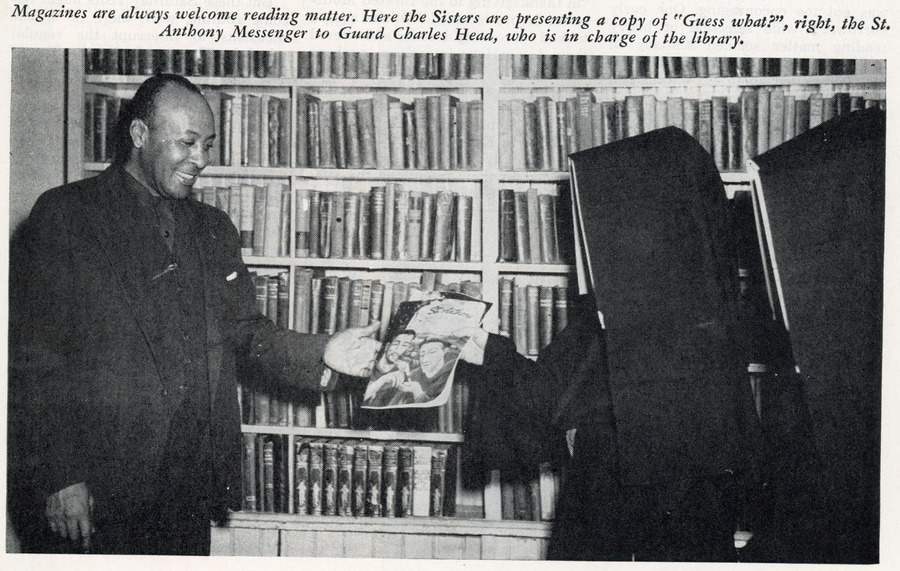
Of course, throughout the years, creating a library was not the only activity Sr. Joan Marie and Sr. Paula brought to the City Workhouse. They would orchestrate Christmas and Easter parties with gifts and entertainment, as well as finding aid for prisoners, like clothing, marriage counseling, and job opportunities. The sisters were well aware of the difficulties those incarcerated were facing, and were willing to listen and help in any way they could.
And those who were recipients of their love and kindness, had so much to say: “For once, I really want to do the right thing. Please pray for me. I’m so happy and proud to be a Catholic, and so thankful you’re a nun. God bless you for all you’ve done for all of us – you’ll never know how much. You wouldn’t believe me if I told you the difference at the prison before I left. Men are saying their Rosary in the chow line. I’ve never been so happy and thankful in all my life!”