Feature
Feature
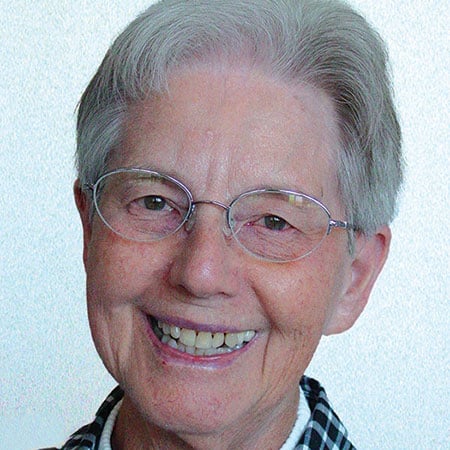
Mary Catherine Widger SL tells the story of a child with an intellectual disability whose parents hoped would make his First Communion. This was in the late 1970s. Mary Catherine served in the special education office for the Archdiocese of Denver, creating programs to bring religious instruction and sacraments to kids with developmental disabilities. In response to the parents’ request, a naysayer in the diocese rejoined that those who could not understand the sacraments should not participate. The Rev. Larry Freeman, with whom Mary Catherine served in the special ed office, asked, “Are you saying that Jesus doesn’t want to be part of this person’s life?”
Helping to open eyes, hearts and minds comes with the territory in special ed work. Since that day in the 1970s, many young parishioners with developmental disabilities have made their First Communion, including the child in this story.
Mary Catherine has spent the majority of her life loving, serving, teaching and being taught by those with disabilities. She has now served in the special ed office for 50 years and knows well the profound effect her young mentees can have on those who connect with them. She tells of a parishioner at a local church who volunteered to help at a program run by the special ed office. At one point, Mary Catherine found him sitting on the floor with a child, tears running down his face. He told her, “I’m a wealthy man. I have a wonderful wife. I have wonderful children. We lack nothing. But I have never experienced being loved completely for who I am and nothing else.”
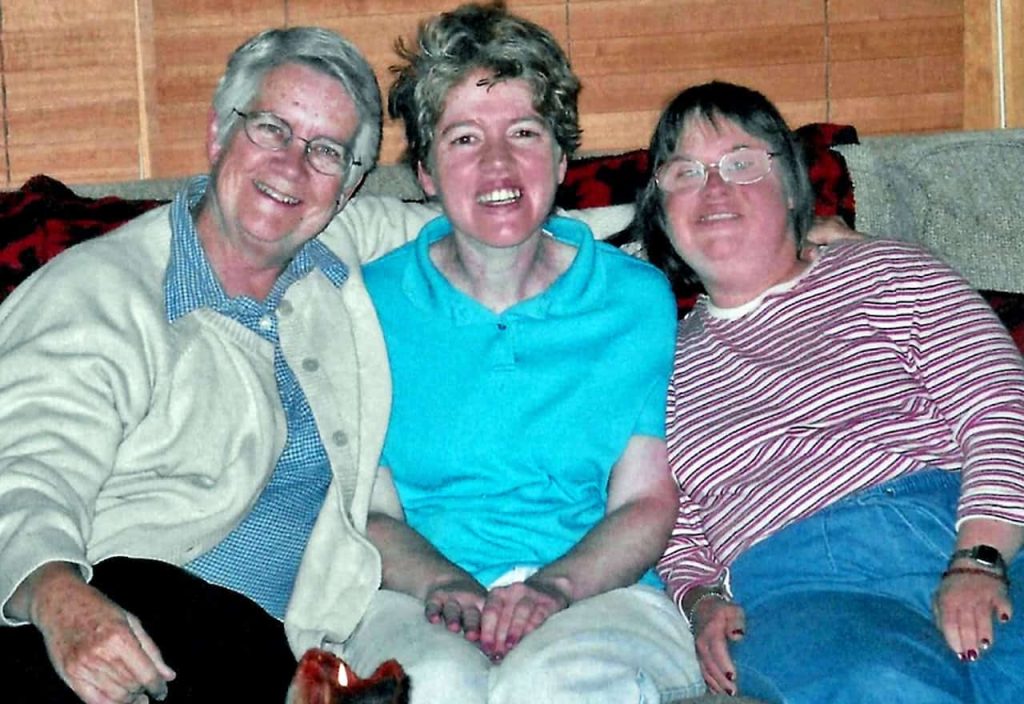
It sometimes happens that only upon reviewing our lives do we discern the moment when the seed of our vocation was planted. For Mary Catherine, that moment came when she was a young student at St. John the Evangelist School in Denver, a school started by Sisters of Loretto in 1924. She was asked to assist a classmate who needed special help because, as Mary Catherine says, “she was a little slower at learning.” She was, Mary Catherine now knows, a lot like many of the young people she has since come to serve. Thirty-two years later, long after Mary Catherine had entered Loretto, she ran into the student she’d once helped. Even after so much time, her former classmate remembered her.
After attending the Loretto novitiate in Kentucky, Mary Catherine initially taught first grade at St. John’s, the school she’d attended as a child. It was in 1976 that the seed planted all those years before stirred into life as she went to work full time in the archdiocesan special education office. She and the other special ed staff members, including Sue Rogers SL and Father Larry, served those with developmental disabilities by training teachers and forming programs in Denver parishes. In those days, they created and oversaw 23 parish programs, with Sue commenting, “Our kids don’t fit into categories. … We have to look at each individual and design a program. There are as many different approaches as there are individuals.”
Mary Catherine had worked in the special ed program for nearly 10 years when, along with Sue and Father Larry, she was called to embark on a new, all-encompassing ministry, one that would more concretely impact lives and pull deeply from her own well of compassion and love. They would open a group home for young women and teens with intellectual disabilities, and the two Loretto Sisters would live in community with them. Veronica Saykally, who now serves as house manager, says, “Everything that Father Larry, Sue and Mary Catherine were experiencing out there led to this home.”
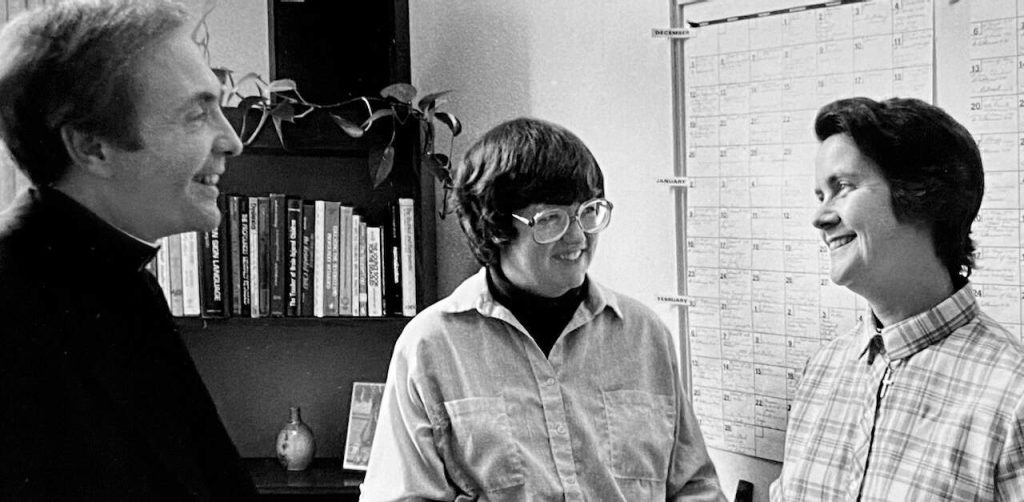
As they set about planning, Mary Catherine remembers Father Larry saying, “We don’t want people to think this is just a good thing for priests and Sisters to do, because it’s so much more than that. It’s the Christian community saying that these people are valued as much as you are, or we are, and when you really love somebody, most people choose to live with them.” Mary Catherine adds, “And so that’s why we started a group home. We love and value these people who are a bit different from some of us.”
The trio received helpful advice from the Jewish Community Center in Denver — they had established a group home for developmentally disabled persons and were happy to share details about their process as the home was launched.
Plans were budding into reality, and, as has so often been the case with Sisters of Loretto undertakings, it became clear that Divine Providence was at work fertilizing the nascent seedling. The former convent across from All Saints Church in west Denver had been vacated and would be a perfect fit, with generous-sized kitchen and dining areas, a cozy living room and small, comfortable bedrooms that could be decorated to suit individual personalities. The backyard was spacious and would turn out to be ideal for gatherings and meals. This would make a perfect family home — albeit for a large family! The seedling was sending out healthy new growth.
Before the home officially opened, Mary Catherine and Sue invited Loretto Community members to come live with them as Bridge was becoming established. In addition to Mary Catherine and Sue, five Sisters moved in. Four briefly resided at Bridge, while Lydia Peña SL stayed until her retirement to Loretto Motherhouse in April 2025.
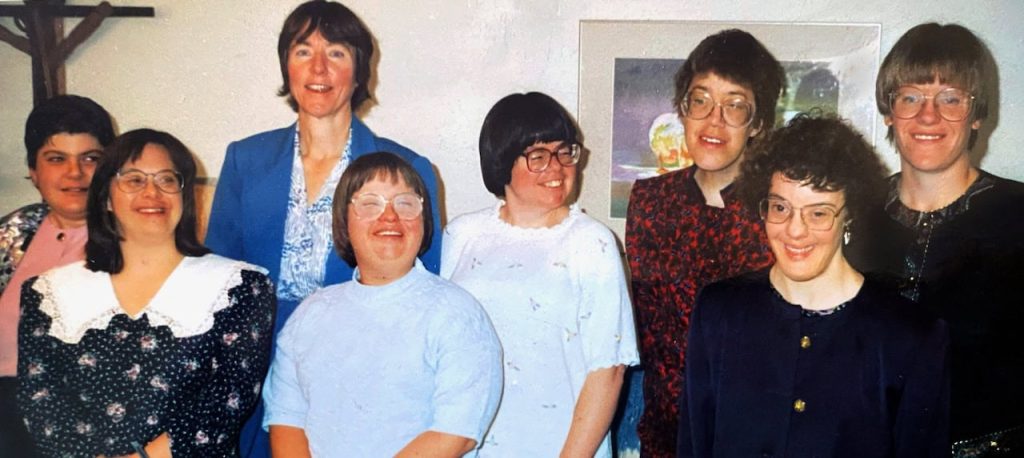
On April 1, 1985, 173 years after the founding of the Sisters of Loretto, five young women with developmental disabilities moved into a new kind of home. Three months later, three more joined the first five. Most of these original residents were known to Mary Catherine, Sue and Father Larry from the archdiocesan special ed program. With the nurturance of the Sisters and staff, the residents would be able to become more independent and live full and fulfilling lives.
Those invited to live at Bridge would require moderate supervision and learn basic self-care tasks and chores. Eventually they would work outside of the community. And Christian instruction would be available.
Most residents have come from Catholic families. Other families, Mary Catherine shares, “were just grateful that their daughters would get the Christian education. We wanted Bridge to mean independence for them, and also to be Christian-based, Catholic-based, wherever we could do that. You don’t have to be Catholic to live or work here — but you have to be okay with our celebrations and daily Masses.” Residents have participated as they are able. One young woman was paying close attention during Mass; when the priest reached the Liturgy of the Eucharist, at the words “Body of Christ,” she loudly exclaimed, “Oh! WOW!”
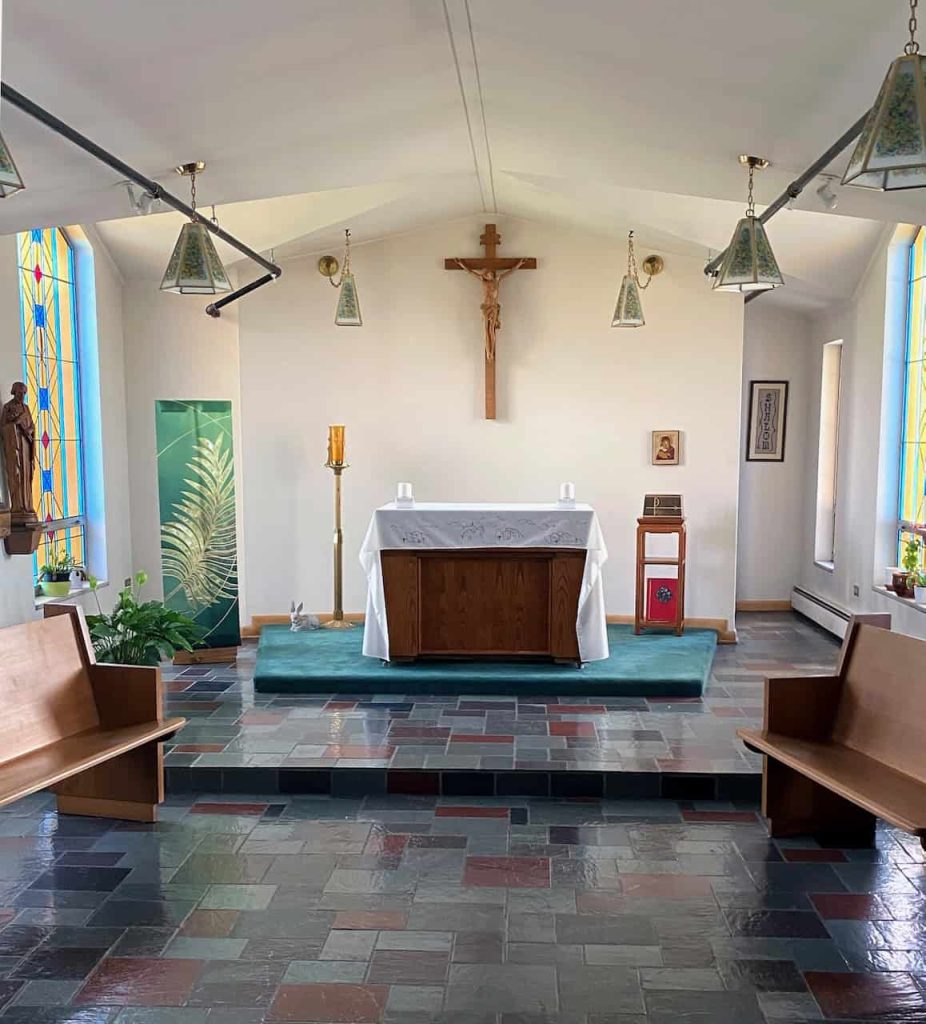
Religious training is, of course, one aspect of the healthy, affirming life Bridge offers. On the practical side, the community has been able to offer day-to-day care, education and opportunities that birth families may not be able to provide. Birth families have been relieved and grateful that their loved ones are happy and safe.
Bridge’s philosophy has always been simple, and remains unchanged. This would be a family. They would experience life’s joys and hardships together, supporting one another through all of it. This home was not meant to be a short-term living arrangement; as long it was a fit for all, as long as Bridge was in place, each individual would be welcome to stay and live as family.
‘People who have limitations and need extra care and aid have a right to have as much normality in their lives as possible, to be able to go places and do things and learn.’
Mary Catherine Widger SL
Love flourishes at the heart of the family. Even so, family life isn’t always easy, and the women’s particular needs can prove challenging. Routine is important, and patience is imperative. When she cofounded Bridge, Sue was an occupational therapist with a lot of experience working with those with special needs. “We couldn’t have done it without Sue,” Mary Catherine says. Sue created step-by-step instructions tailored to each resident. These set out how to perform hygiene tasks, do laundry, clean a bedroom, ride the bus, etc. She created programs for staff that outlined each step involved in the tasks an intellectually-disabled person would learn. These are still in use. Mary Catherine says, “They needed help in critical areas in order to gain more independence. That was part of our job, to do that in a home atmosphere with friends — we did become good friends.” The women learned how to complete chores around the house: helping with dinner, cleaning up after a meal, watering plants. Everyone was learning “the everyday stuff,” Mary Catherine explains, “all the mom things.” Remembering it all, though, can be tricky. “We still work on it,” she says.
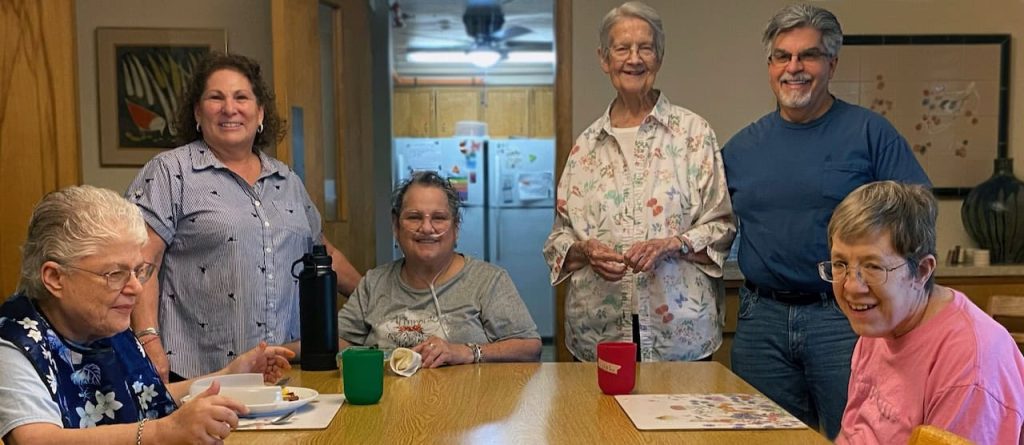
Sue shares that early on she, Mary Catherine and Father Larry learned that people with intellectual disabilities “have meaningful lives.” Many of us think of special needs individuals as recipients of others’ gifts; as Sue says, they, too, have “gifts they want to share.”
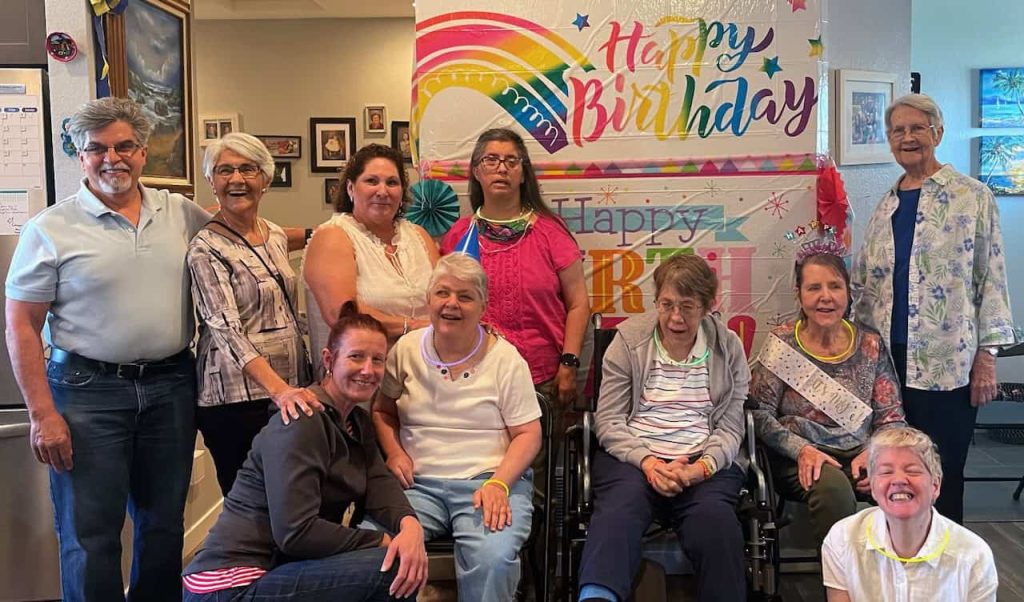
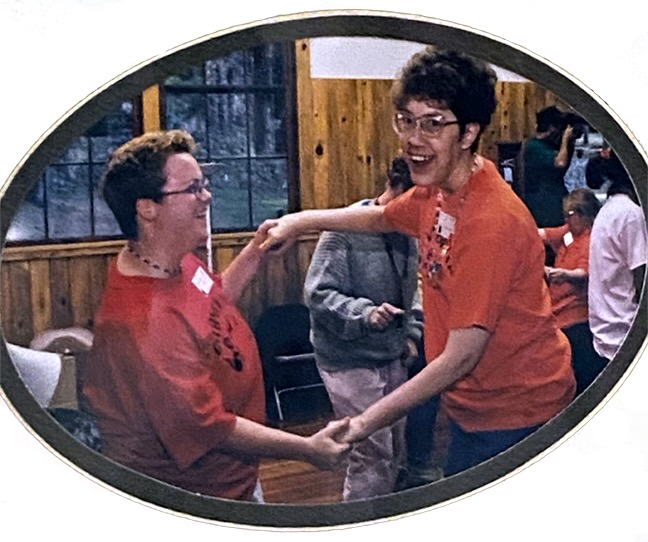
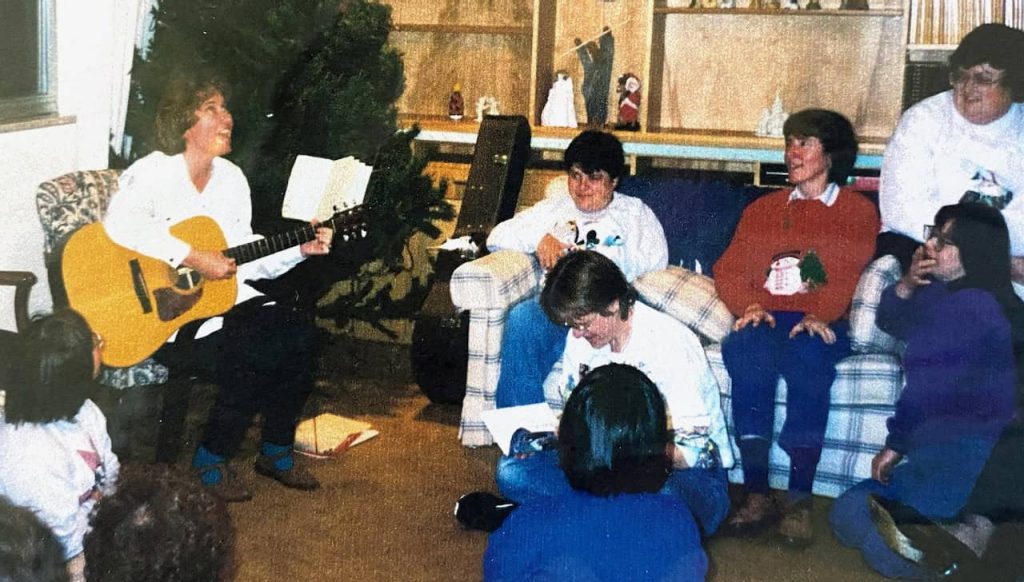
Sue says that celebrations were significant in the community from the start. “We celebrated a lot. Life needs more celebration than we can imagine.” Commemorating the little things is important, since the residents do not experience many of the usual societal milestones.
Starting Bridge with Mary Kay and Father Larry, Sue says, “was one of the most exciting things we ever did.” Sue lived at Bridge for more than 20 years and then moved to Loretto Motherhouse and opened an occupational therapy practice in Kentucky, working with infants and young children, service she loved. She is now retired.
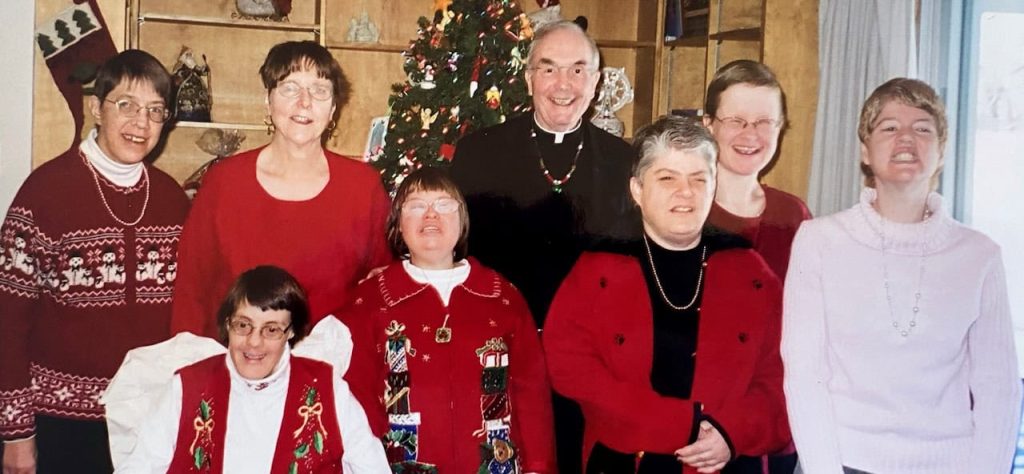
Of course, Bridge has known all the ups and downs of family life: together time, vacations, disagreements, parties, funerals. Looking back, the greatest challenge was the growing up process, “for the women, and for ourselves,” Mary Catherine shares. Now they’re experiencing the aging process together. Mary Catherine says, “We’ve had lots of adventures, lots of sadness. Lots of death.” Developmentally-disabled individuals age more rapidly than the general population, and recently, Bridge has mourned the loss of several longtime family members.
The community experienced an early, significant loss with the death of Father Larry in 1998. His twin brother, the Rev. Roland Freeman, stepped in and became a beloved friend and pastor to Bridge as his brother had been. He, too, served in the archdiocesan special ed program.
In Jan. 2025, Fr. Roland died, and grief again descended on the community. He had served as a parish priest at All Saints Church across the street, where he lived in residence, and had always been available to Bridge residents and staff. During the recent pandemic, he’d begun holding Mass in the Bridge chapel every day.
The coronavirus years, starting in March 2020, proved difficult for the community. Suddenly, life irrevocably changed. The women could not go to work. Family members were not able to visit. In addition, “when Covid hit, all the day programs closed,” Mary Catherine says. “The women had been going out to workshops and community centers. That all stopped immediately because of the contagion.” Longstanding routines were thrown to the wind as a maelstrom of uncertainty swirled around the strong tree that Bridge had become. Residents missed birthdays and holidays with their birth families — though the families rallied, organizing drive-bys, honking horns and waving from cars festooned with balloons.
‘They don’t judge; they love. They are wonderful. They teach you so much.’
Veronica Saykally
Prior to the pandemic, employment had been an important aspect of the women’s independence. Veronica, Bridge’s house manager, says, “Every day, they were faithful. They wanted to go to work, to go out into the community. They got up every morning, they would make their breakfast, they would make sure their lunch was made the night before and their clothes were ready.”
Their employment varied. Mary was a janitor at a daycare center. She got on the bus, Veronica says, “winter, summer — she would get on that bus and go to work. She loved it.” A couple of the women worked at the Denver Zoo. Another was employed at a bindery. One worked at the Westin Hotel in downtown Denver helping to clean rooms, and another at a grocery store. The women have not returned to work.
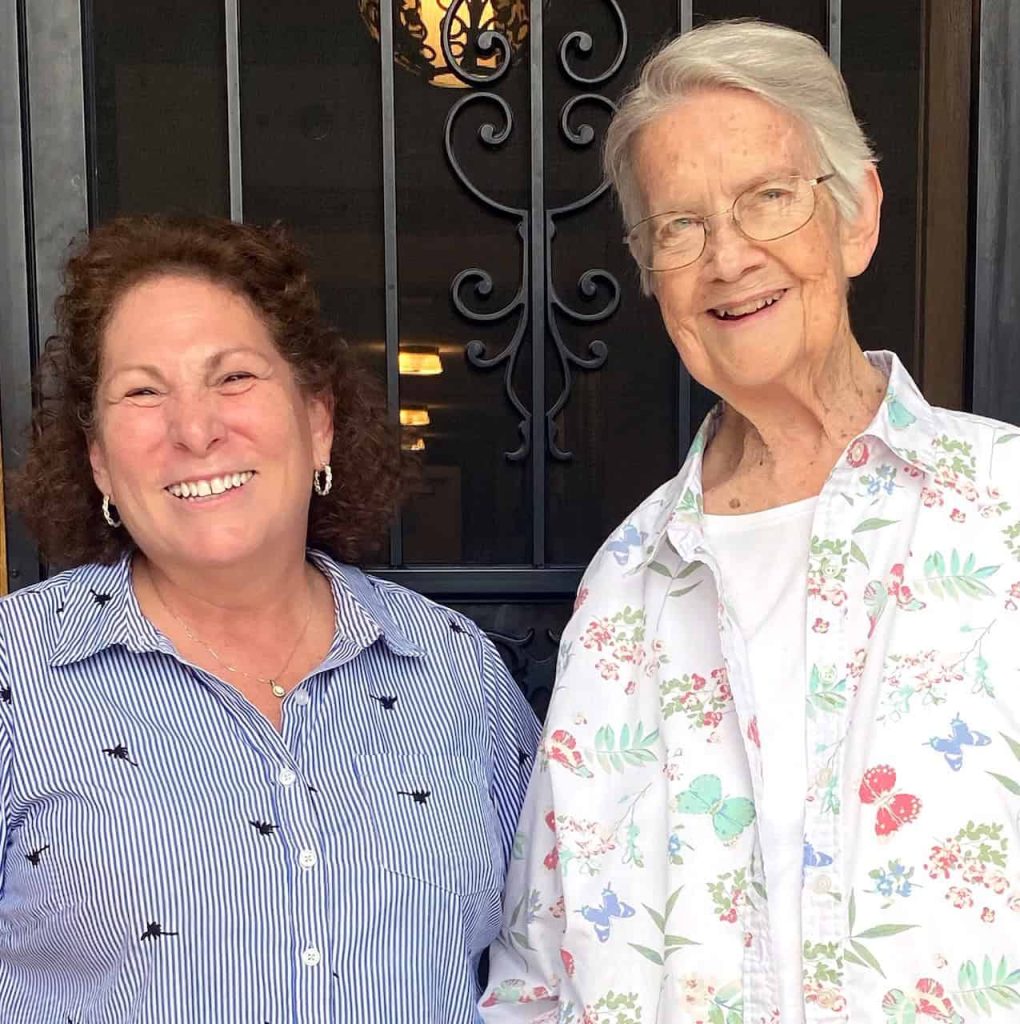
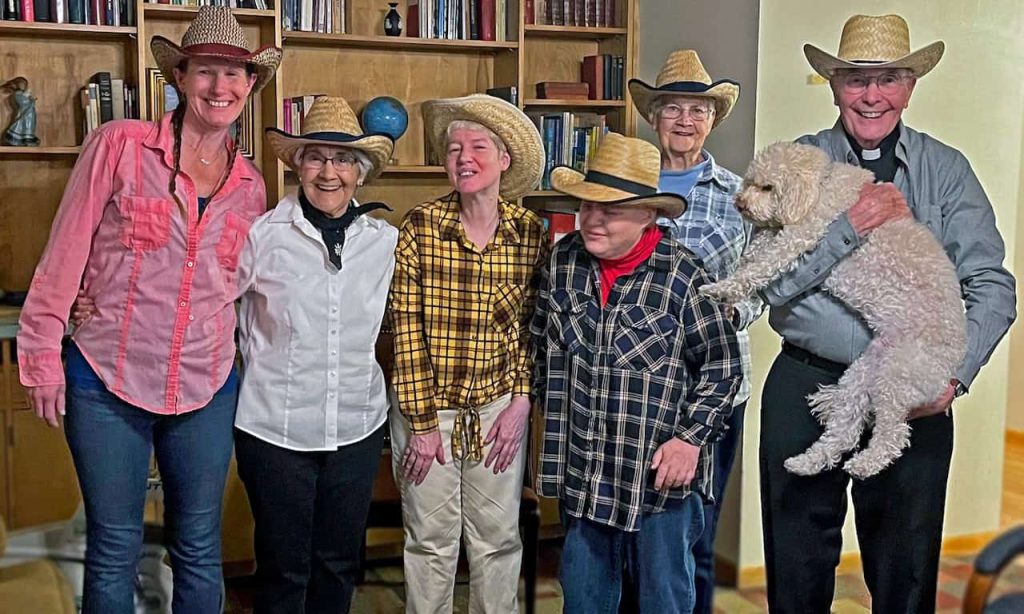
Over the years, Bridge has been home to around 20 residents, each one a precious gift. Many have lived their entire adult lives within the loving arms of the community. Currently, three women — ages 67, 62, 57 — reside at Bridge, assisted, cared for and loved by Mary Kay and Veronica, with a total of nine staff. Two of the residents have been members of the Bridge family for more than 30 years, and the other for 21 years.
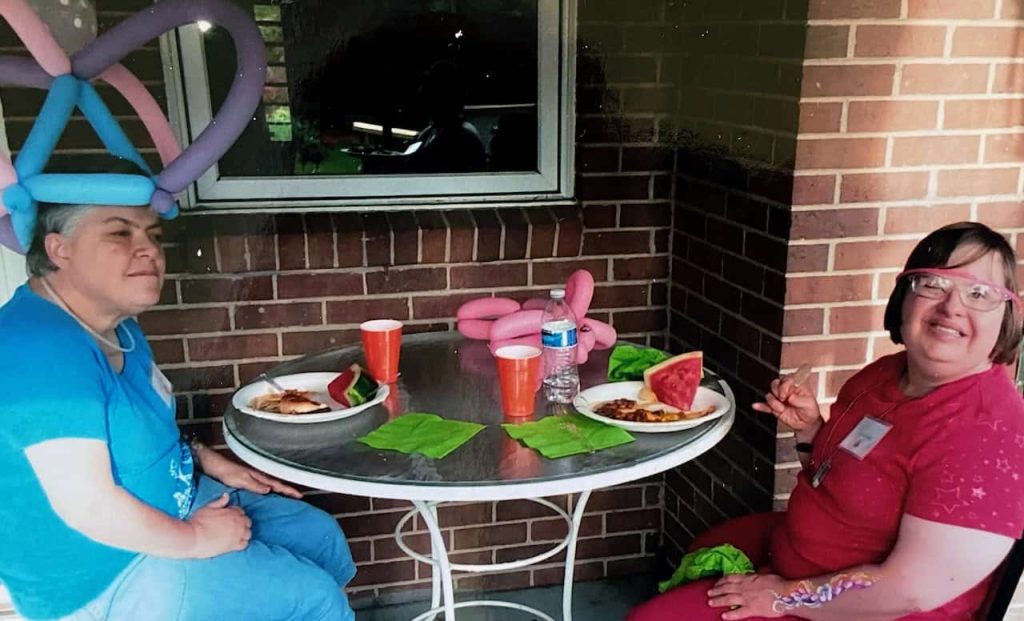
As memories slip, and they must relearn many of the tasks they’d previously mastered, Veronica says, “Staff has to do more for them.” During the past six years, since the start of the coronavirus pandemic, Bridge residents have experienced significant decline, the primary reason they have not returned to work.
The women still enjoy going out to movies, and they love shopping. Recently, along with Mary Catherine and staff, they enjoyed a three-day vacation to Colorado Springs, Colo. Birthdays and holidays remain vital celebratory occasions.
Through the last four decades, through the ups and downs and tears and laughter, love has sustained the community. The seed that was planted more than 40 years ago has grown into a healthy flowering tree with strong, deep roots, and it has weathered the storms. Mary Catherine’s life has been immeasurably blessed by all those with whom she has lived and served. They have taught love, trust, patience. She has given so much of her life, and has received as much in return.
All these years, Mary Catherine has continued the special education work for the archdiocese alongside her service at Bridge. She lights up telling Julie’s story. She first met Julie, a young woman who was completely paralyzed, in 1995. Julie attended church every week, her parents toting along all of her medical equipment. Mary Catherine took Julie under her wing, working with her until she made her First Communion two years later. She still visits Julie, who is now 50 and kept alive by machines, every Friday. “You walk in the room,” Mary Catherine shares, “and she says ‘I love you’ with eye blinks and a huge smile.”
Thank you, Mary Catherine and the Bridge Community, for the love you live day in and day out. As Loretto President Buffy Boesen SL writes in the opening letter to this magazine, “I know that my life is enriched by this steady, quiet, peaceful and life-giving work.” So it is for all of us who have experienced the love and joy that lives at the heart of the Bridge Community.
Read all of the articles in the winter 2026 issue of Loretto Magazine here.