In Memory
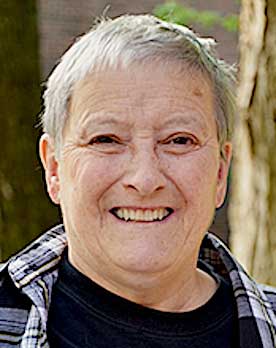
Sister Jeanne (formerly Sister Eugenie Marie) Dueber SL died Jan. 25 at Loretto Living Center in the 67th year of her Loretto commitment. Jeanne was 88, a well-respected artist, sculptor and teacher. Members of the Loretto Motherhouse Community and of her family lovingly watched with her through her final weeks.
The following is Jeanne’s autobiography, as presented at Jeanne’s wake Feb. 6 by Eleanor Craig SL:
“I was born July 14, 1937, in St. Louis to Dorothy Carpenter Dueber and Clarence Dueber, the second of 10 children, two of whom died in infancy. We lived in Little Flower Parish where I went to kindergarten and first grade. We moved to Mary Queen of Peace Parish, but since the school wasn’t open yet, my older sister, Joanne and I took the bus to Holy Redeemer School. The next year we went to Mary Queen of Peace school being held in the priest’s house. Sister Ann Mary Schilling was my third-grade teacher. My fourth grade teacher, Miss Kennedy, didn’t give us homework so I went to Sister Ann Mary every afternoon and she gave me some. She was a noble soul!
“The new school opened and I completed fifth and sixth grade there. My Dad got transferred to Cedar Rapids, Iowa, for two-and-a-half years where I completed seventh, eighth and three months of my freshman year at two Catholic schools. Dad rented this big house from an old man on the outskirts of town with 13 acres. Things were pretty rundown, but we had all this land to work and run with. That’s when I really started working with my Dad fixing things, as my oldest brother was only 4 years old.
“There were orchards on the property, a strawberry patch, wild gooseberries, blackberries and wild cherry trees. We started a nice garden. In the cold winters we cleared the backyard, and Mom flooded it so we could ice skate. As we were growing up, our vacations in the summer were going to my grandmother’s farm in Cole Camp, Mo.
“In the middle of my freshman year we moved back to St. Louis to Holy Redeemer Parish. My sister Joanne’s friends were attending Eugene Coyle High School in Kirkwood, so, of course, I went there, too. Joanne graduated after my sophomore year so I went to the pastor at Holy Redeemer and asked him if he could possibly give me a scholarship to Nerinx (five blocks from my house, therefore, no bus fare)! He gave me half tuition so I went to Nerinx my junior and senior years. I could then be of more help to my mother, especially in my senior year when my youngest brother was born.
“I was very interested in science and art. I had my first art class at Nerinx with Ann Walsh Torrini, [illustrator and portrait artist and wife of Rudi Torrini, who would become my sculpture mentor.] In 1955 I won a science fair competition with my working model of the human circulatory system, for which] I obtained a scholarship to Webster. I had a career in medical illustration in mind. After my sophomore year I decided that I preferred being more creative.
“While at Webster I was active in the Sodality. After my junior year, in 1958, I entered the Loretto Novitiate. During the three novitiate years I taught some art history and lettering. In the fall of 1961 I returned to Webster to finish my degree. Living at the House of Studies, I helped with designing the chapel for the new wing and made two sets of stations, one for the Motherhouse. I was assigned to Loretto in Kansas City while it was still on 39th and Roanoke. That was the fall of 1962, and I had finished the stations in St. Louis just three days before school started. I was to start an art department and teach religion, art. An art appreciation class developed with collaboration from other teachers, a wonderful program for Seniors entitled “cultural patterns,” with music, dance, drama, history and art interwoven.
“I made final vows in the summer of 1966, returning to Kansas City to the newly built Loretto school on Wornall Road. In 1968 I was accepted to graduate school at the University of Iowa where I received an MA in sculpture the next year. I returned to Kansas City to continue teaching. We mixed middle -school students with those from the upper school, and it became a real creative situation. I changed their media every three weeks so no one would get bored. We displayed the students’ work in the halls and other peoples’ work as well. These exhibits really enhanced the students’ own work.
“All along I had been doing my own work, teaching at the Nelson Art Gallery and the Kansas City Art Institute, participating in art fairs, exhibiting in various places as well as at Loretto in Kansas City. I traveled to Mexico in the summer of 1969. For the summer of 1971 I received a Fulbright-Hayes grant to study art history in Italy; [The next summer I returned to travel through seven European countries studying architecture.] Over the years I kept up with important exhibits shown in New York, Philadelphia, Washington D.C., Chicago, St. Louis, Kansas City and Santa Fe. In 1995 I took a solo two-week trip to Peru to experience a different culture.
“I had taught at Loretto in Kansas City starting in 1962 until 1976. There were more and more demands for my own art work, so I devoted full time to it the school year of 1976-77, working in a room in the school. The summer of 1977 the school asked me to build a studio as they needed that room. Sister Helen Sanders, president at the time, asked me if I would consider moving to the Motherhouse. I thought I would get space in the unused laundry building. I agreed because I liked it down here. I had spent the summer of 1976 constructing the triptych of our foundresses in a log cabin school. It was to commemorate the nation’s bicentennial. I had done that work on the Rhodes Hall porch. I didn’t realize that I would get Rhodes Hall to use the next year! It is perfect for gallery and work space. Other uses had not been found for Rhodes because of all the steps, landings, etc. It had been vacant 10 years before I got here. The firemen made inspections, and Joey Edelen told me if I felt the seat of my pants get too hot just run!
“Sister Alban offered to help renovate the building. It was a big job and it took us nine months, converting the second floor into a gallery and living quarters, and a studio on the first floor. Alban could write a book about it. She continued working with me, and I really benefitted from her creative mind. She’d take a sculpture I was working on and tell me, “It would look better if you turned that one piece upside-down.” Well, she was right.
“I moved from Kansas City in 1977. January until Thanksgiving of 1980 I spent full time helping to renovate the Motherhouse church while the gallery ran on its own. In 1982, in order to enhance the new wing of the infirmary I was asked to build a fountain in the new courtyard garden. That took three months. Over the years, I’ve had other good help. Mary Gutzwiller helped during her novitiate year and [has come back for more.] Then Sister Matthew Geraghty helped for several years. We did some interesting (and otherwise) things together. She also could write down some tales. Jimmy Higdon wanted to apprentice with me for three weeks in the summer of 1996. I needed a project to focus on so I broke down and tackled Father Badin’s statue, which was falling apart, and we made a new one. It took longer than three weeks. Jimmy, after that, decided not to go into sculpture, but to stick with poetry. I spent the rest of the summer making major repairs on the cemetery statues.
“The only way the gallery has changed over the years is by the addition of new pieces. I don’t see it changing in the future until the time comes when I can’t do all the steps. The gallery receives many visitors: individuals from Gethsemane, Bethany Springs, Knobs, tour groups and our own Loretto visitors. Schools from the immediate area, as well as Campbellsville and Bowling Green, inform me that I’m the only art museum in the area, and it helps them that I work in so many media. It would help if I were more of a people-person and had the gift of gab, but then, I wouldn’t get any work done. I do make sales from visitors to the gallery but mostly, I make my living from commissions.
“I am a builder and my technique is primarily additive. I am constantly involved with large-scale pieces while at the same time several smaller pieces will also be in progress. I find that the contrast in size opens my eyes as I oscillate from one scale to another. I don’t ever want to be stumped by what happens. Going with the flow is more than a cliche for me; out of reverence for the material I try to follow its voice, too. … My pieces generate an open-ended, risk-taking approach to life rather than a smooth-finished, play-it-safe passive attitude. … My ‘Fiat’, for example, is a celebration of the fun and color of living, a tribute to the tremendous energy, rhythm and grace of the human body involved fully with life.”
Jeanne’s work is included in 16 corporate collections, including those of Humana, Brown-Forman Distilleries and Hallmark Corp. Private collections in the U.S., Canada and England are home to more than 400 pieces. Jeanne’s work has been exhibited in more than 100 shows, 26 of which featured only her work. In 1995, KET, Kentucky’s PBS affiliate, produced a TV documentary about her.
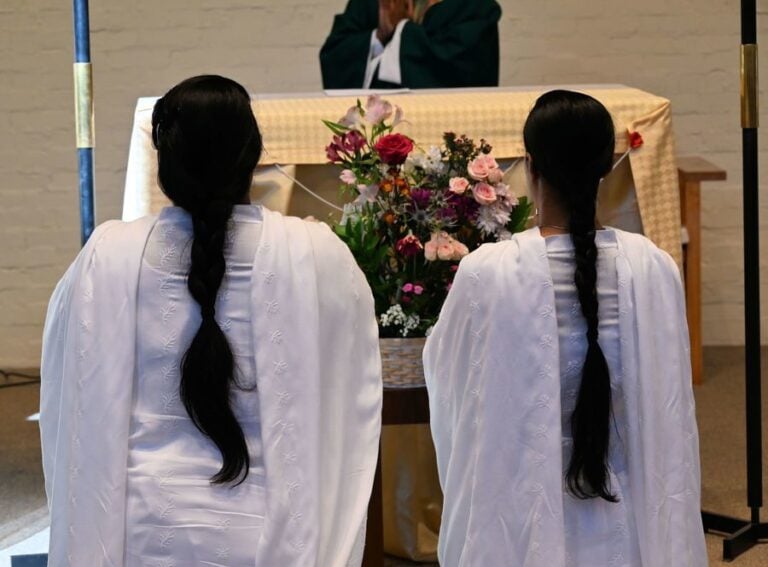
A funeral Mass for Jeanne was celebrated Feb. 7 at Loretto Motherhouse, with the Rev. Terry Bradshaw as celebrant. Burial took place at Our Lady of Sorrows Cemetery on the Motherhouse grounds.
Please keep Jeanne, her family and all her loved ones in your prayers. May she rest in peace.